
Literary Agents and Irish Fiction
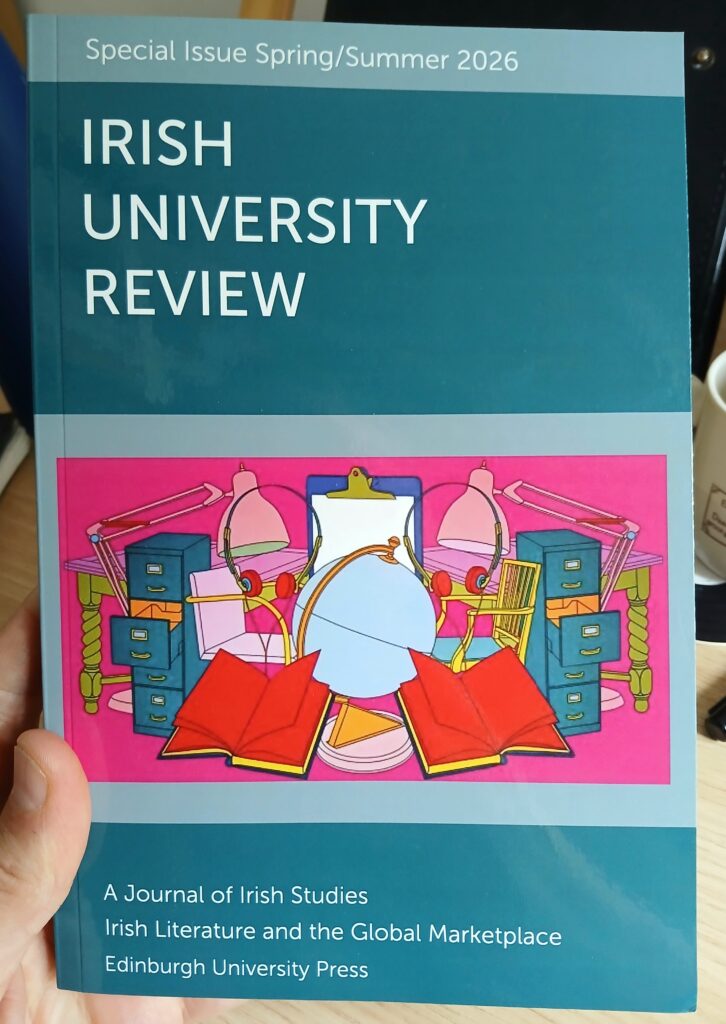
I wrote an article on “Literary Agents and Irish Fiction” for the new issue of the Irish University Review. It’s open access, and you should be able to read it here. The article appears in a special issue on “Irish Literature and the Global Marketplace,” edited by Yen-Chi Wu and Lauren Ottaviani.
The article asks a set of related questions about literary agents, and specifically about their place in the literary ecosystem/industry of “Irish literature.”
There’s been a lot of interesting scholarship in recent years dealing either directly or indirectly with the role of literary agents – most obviously by Laura B. McGrath, but also by Clayton Childress, John B. Thompson, Dan Sinykin, Claire Squires, and Simone Murray. My essay proceeds from the sense that a lot of this scholarship is very US- or UK-focused, and that it would be interesting to see how the dynamics of agenting play out in my own, smaller, country. (Also – there’s a lot of excellent research on Irish literature and publishing, but less of an identifiable wave of literary sociology compared to contemporary US literary studies, for example, so there’s a lot more work to be done on Irish and Irish-adjacent literary institutions and mediators). There’s a lot that we don’t know, for many of the obvious reasons we don’t know things about contemporary publishing: the field is large and confusing, a lot of knowledge is sensitive/implicit/proprietary, and (from a scholarly perspective) it takes time and legwork to interview people and get a peek behind the scenes.
What do literary agents do for Irish authors? Where are these agents based? How does the gravitational pull of London influence the field? How has the recent “golden age” of Irish fiction played out behind the scenes: and are UK publishers (as one author interviewee suggested, in one of my favourite quotes from the piece) collecting Irish writers “like Pokemons”? I interviewed a set of twenty authors, agents, and editors (at various career stages, with a range of publishing experiences – I’ve kept their identities anonymous) to try to venture some answers.
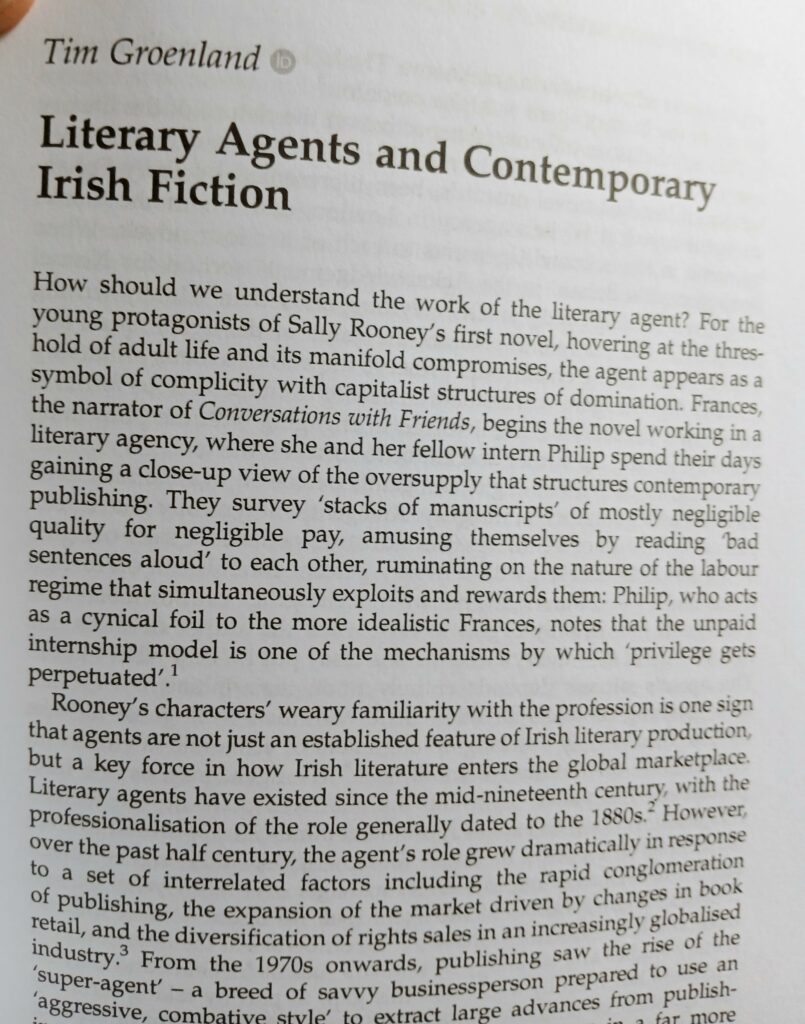
The key dynamic that I explore in the essay is the one created by Ireland’s unusual status as a country producing primarily English-language writing, situated close to one of the major power centres of global publishing, but at enough of a remove to create a cultural gap. One author claimed (in quotes that didn’t make it into the final draft) that for UK publishers, Irish authors are “different but not alien”; “slightly exotic” while still being “something they feel they have a pretty good handle on.” Another author spoke thoughtfully about the ever-present question of “how much translation you want to build into your work strategically, if you want to be read in the centre.” Since Irish publishing is relatively small, and the majority of Irish writers will, when they reach a particular level of commercial success (or, importantly, perceived commercial potential) at least consider signing a book deal with a larger UK publisher (often an imprint of a conglomerate), I conclude that “the job of the agent of an Irish fiction writer, understood as such by both author and agent, is largely to create and maintain working relationships with publishing institutions in London.”
The essay surveys some of the major players to give a rough typology of the field: Marianne Gunn O’Connor is “the Irish agent,” Lucy Luck is “the agent with an Irish list,” and Peter Straus is “the super-agent.” I also build on McGrath’s notion of “corporate taste” – a synthesis of aesthetic judgement and market imperatives that is continually honed with constant reference to “that which is commodifiable, developed from careful study of the industry and the market” – to suggest that agents of Irish writers need to continually exercise “global taste.” An agent needs to smooth the frictions between the local scenes in which Irish writing is frequently developed, and the global markets that promise to support a sustainable literary career. In the final section, I look at two very different novels featuring agent characters, published at very different scales – Brendan Mac Evilly’s art-world satire Deep Burn, and Sheila O’Flanagan’s bestselling romance The Honeymoon Affair – to show how both are “structured by an interplay between nearness and distance – sensitivity to the domestic sphere on the one hand, and access to overseas centres of industry on the other” that echo the dynamics emerging from my interviews.
There’s much more I could have written about, and that I had to cut from this piece; I might revisit this elsewhere in future. Once again, the essay is here and the full issue is here. The whole issue is excellent, and very thoughtfully put together: I’d recommend all the other essays, but I’d note that Dilâra Yilmaz’s deeply-researched essay on Irish arts subsidisation and literary infrastructure also digs in some of the same ground as my research, and complements my piece nicely.